International Music Competition Judge
50+ Gold Prizes Won by Students
40+ International Teacher Awards
International Interviews (UK)
2025: Global Influential Times &
World Org. for Art & Design
2024: Beeffie Artist Award Org.
Discover what international winners say about learning under Ms. Jin Loh (watch video 2.5 mins)

ABRSM Music Theory Online Lessons
(Grades 1–8)
GUIDED BY INTERNATIONAL AWARD-WINNING MUSIC EDUCATOR MS JIN LOH
ABRSM Music Theory Online Lessons for Grades 1–8 are guided by International Award-Winning Music Educator Ms Jin Loh, whose students have developed a strong record of academic excellence in ABRSM theory examinations. Over the years, many students have achieved Distinctions, with several attaining High Distinction results, near-full marks, and in some cases Full Marks in the new ABRSM Music Theory examinations across multiple years.
As a musician formally trained in both classical and jazz traditions, Ms Jin Loh brings a deep and comprehensive understanding of Western music theory to her teaching. This strong theoretical foundation allows students to approach ABRSM music theory not merely as an examination requirement, but as an essential framework for musical understanding that supports instrumental and vocal studies.
Students join these ABRSM Music Theory online lessons from Kuala Lumpur, Petaling Jaya, Bangsar, Mont Kiara, Damansara and across Malaysia, as well as internationally from Singapore, Thailand, Hong Kong, Australia, Japan, the United Kingdom, the United States and other regions worldwide. Through carefully structured guidance and clear explanations, students are supported in building confidence and analytical understanding as they prepare for ABRSM Music Theory Grades 1–8 examinations.

Proven Full Marks Achievement
in ABRSM Music Online Theory Examinations
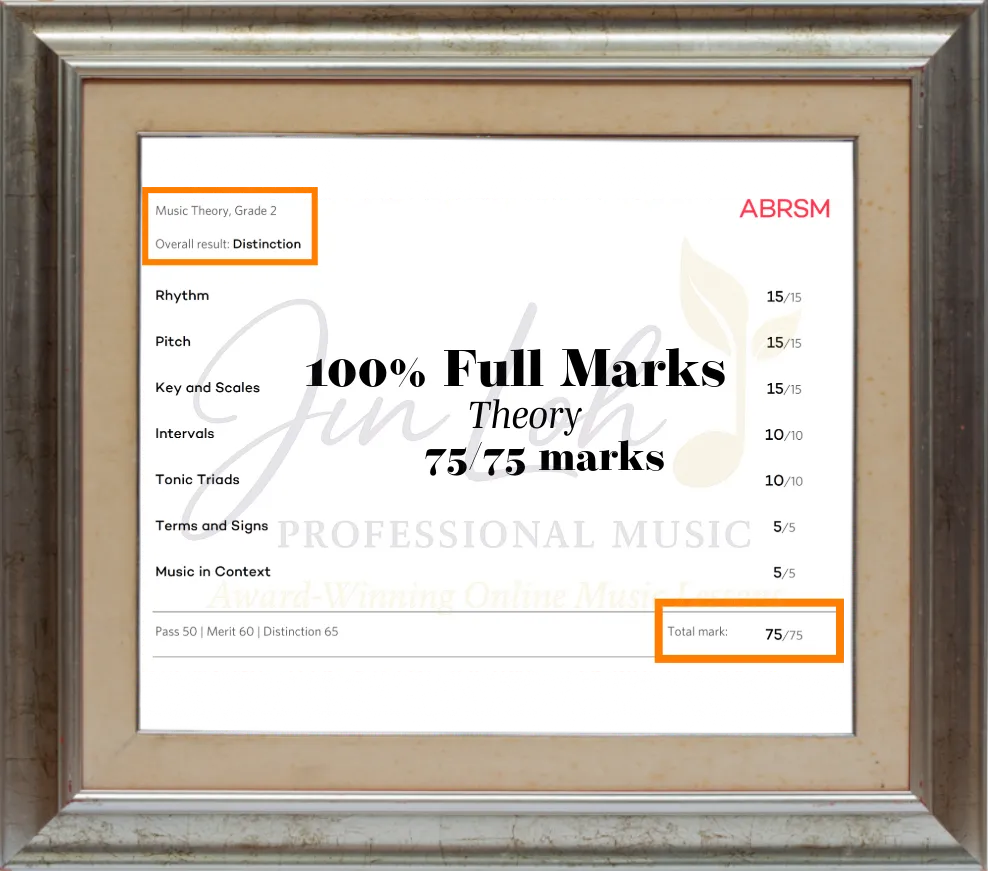 ABRSM Music Theory Online exam marksheet showing full marks (75/75). One of Ms Jin Loh’s theory international students achieved full marks in two consecutive ABRSM Music Theory examinations.
Full marks in ABRSM Music Theory examinations remain a rare achievement, reflecting exceptional accuracy and a deep understanding of theoretical principles.
One of Ms Jin Loh’s international theory students achieved full marks (75/75) in the ABRSM (UK) Music Theory Online examination. The student, based in Thailand, studied entirely through online lessons, demonstrating that structured and carefully guided online learning can be highly effective for developing strong theoretical understanding.
Under Ms Jin Loh’s guidance, the student achieved full marks in two consecutive ABRSM Music Theory Online examinations, reflecting both consistent preparation and a clear grasp of the theoretical principles required for the syllabus. This achievement illustrates how focused instruction, combined with systematic explanation and disciplined study, can lead to outstanding academic results even when lessons take place across international distances.
As an International Award-Winning Music Educator, Ms Jin Loh’s teaching emphasises clarity, musical understanding and analytical thinking. Through carefully structured online lessons, students are supported in building a solid theoretical foundation while preparing confidently for ABRSM Music Theory examinations.
This example reflects how students from different parts of the world are able to engage in ABRSM Music Theory online lessons and achieve strong academic outcomes through thoughtful guidance and consistent study.
High Distinction Achievement
in ABRSM Music Theory Grade 5
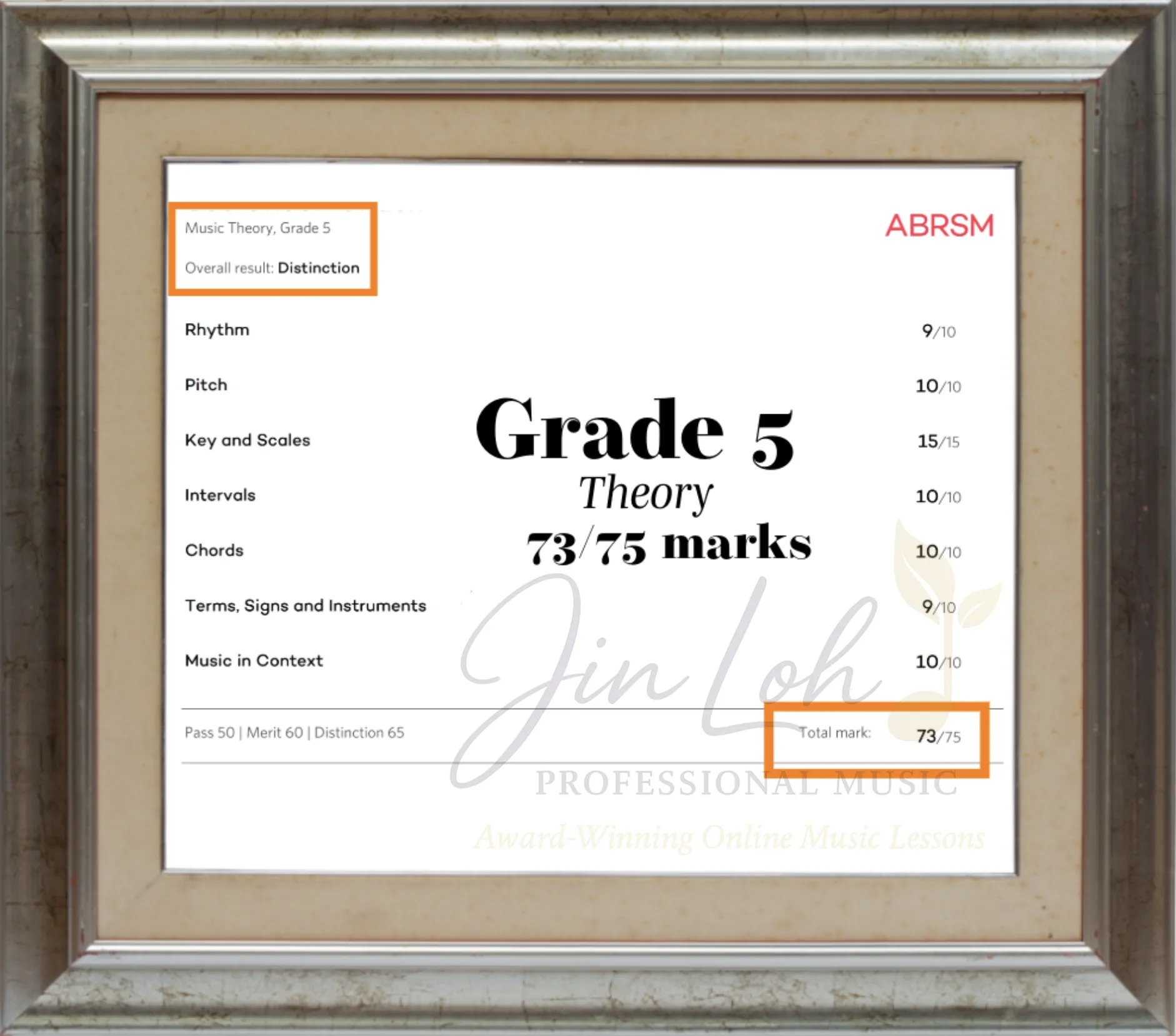 ABRSM Music Theory Grade 5 marksheet showing 73/75 marks. The student also achieved 73/75 in Grade 4, demonstrating consistent high distinction results under the guidance of Ms Jin Loh.
ABRSM Music Theory Grade 5 is widely regarded as a particularly important milestone within the ABRSM examination system. A pass in Grade 5 Music Theory is required for students who wish to progress to Grade 6 and higher practical examinations, making it a significant stage for many instrumentalists and singers preparing for ABRSM (UK) practical music exams.
One of Ms Jin Loh’s online theory students in Malaysia achieved 73/75 marks in the ABRSM (UK) Grade 5 Music Theory Online examination, representing a near-perfect result. The student had previously achieved 73/75 marks in ABRSM Grade 4 Music Theory, demonstrating a consistently high level of accuracy and theoretical understanding across consecutive grades.
Notably, both examinations were prepared through fully online lessons, illustrating that structured and carefully guided online learning can be highly effective for ABRSM Music Theory preparation under an International Award-Winning Music Educator, Ms Jin Loh. Through systematic explanation and focused guidance, students are able to develop strong analytical skills and confidence when approaching the ABRSM theory syllabus.
These results reflect how students studying ABRSM Music Theory online can achieve strong academic outcomes while preparing for the important theoretical requirement that supports progression to higher-level practical examinations.
ABRSM Music Theory for
All Instrumentalists and Singers
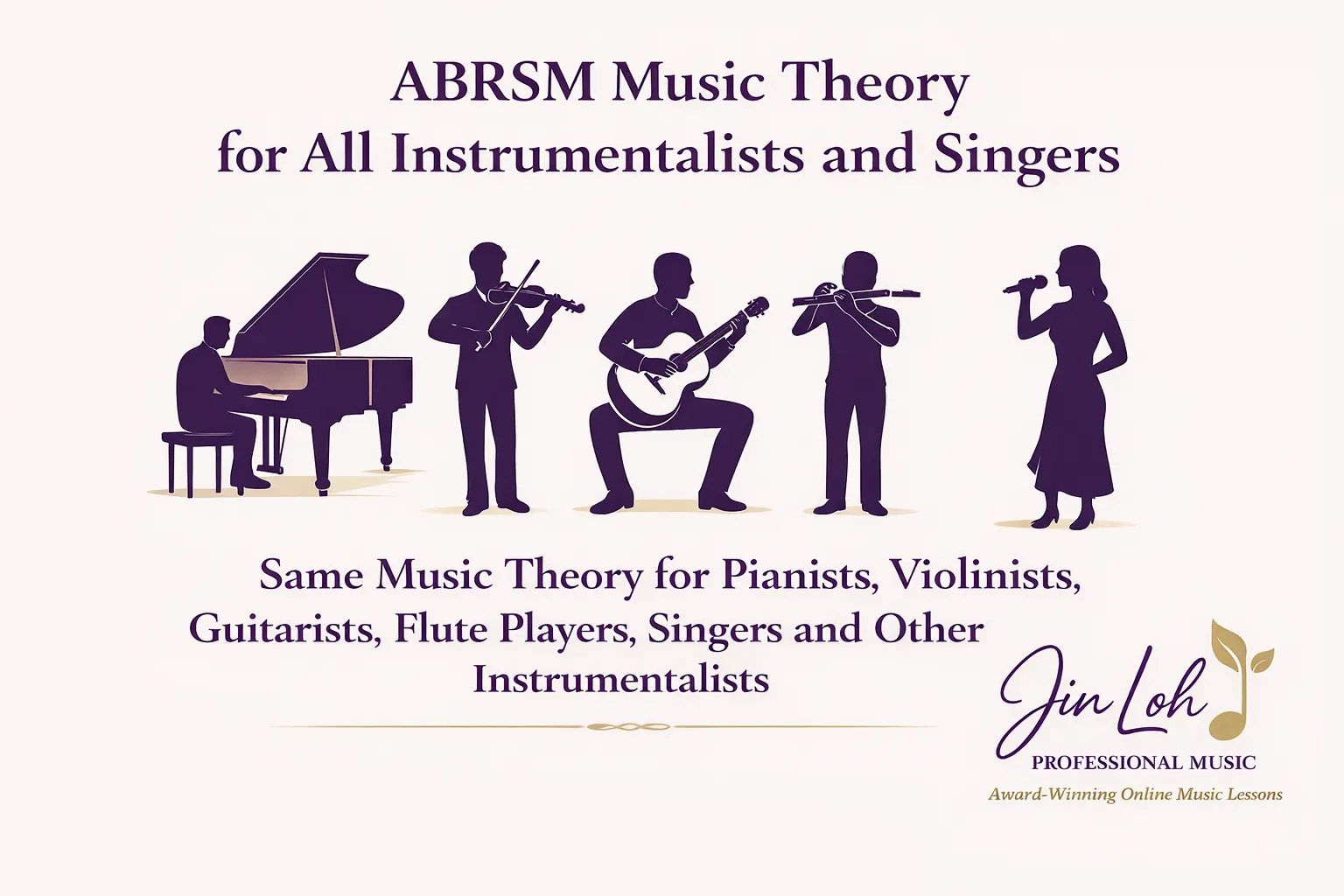
ABRSM Music Theory is a unified syllabus designed for all musicians, regardless of their instrument or area of study. The theory curriculum is the same for pianists, violinists, cellists, guitarists, singers, flautists, drummers and other instrumentalists preparing for ABRSM examinations.
In other words, there is no separate theory syllabus for different instruments. A singer studying for ABRSM examinations learns the same music theory as a pianist, violinist or guitarist. The theoretical principles—such as notation, rhythm, harmony, scales and musical structure—are shared across all areas of Western classical music.
For this reason, students from a wide range of musical backgrounds join ABRSM Music Theory Online Lessons with international award-winning music educator Ms Jin Loh. Whether a student is preparing for ABRSM piano, violin, cello, guitar, singing or other instrumental examinations, the same ABRSM Music Theory syllabus provides the essential theoretical foundation that supports their musical development and examination preparation.

Classical and Jazz Training:
Understanding Both UK and US Music Terminology
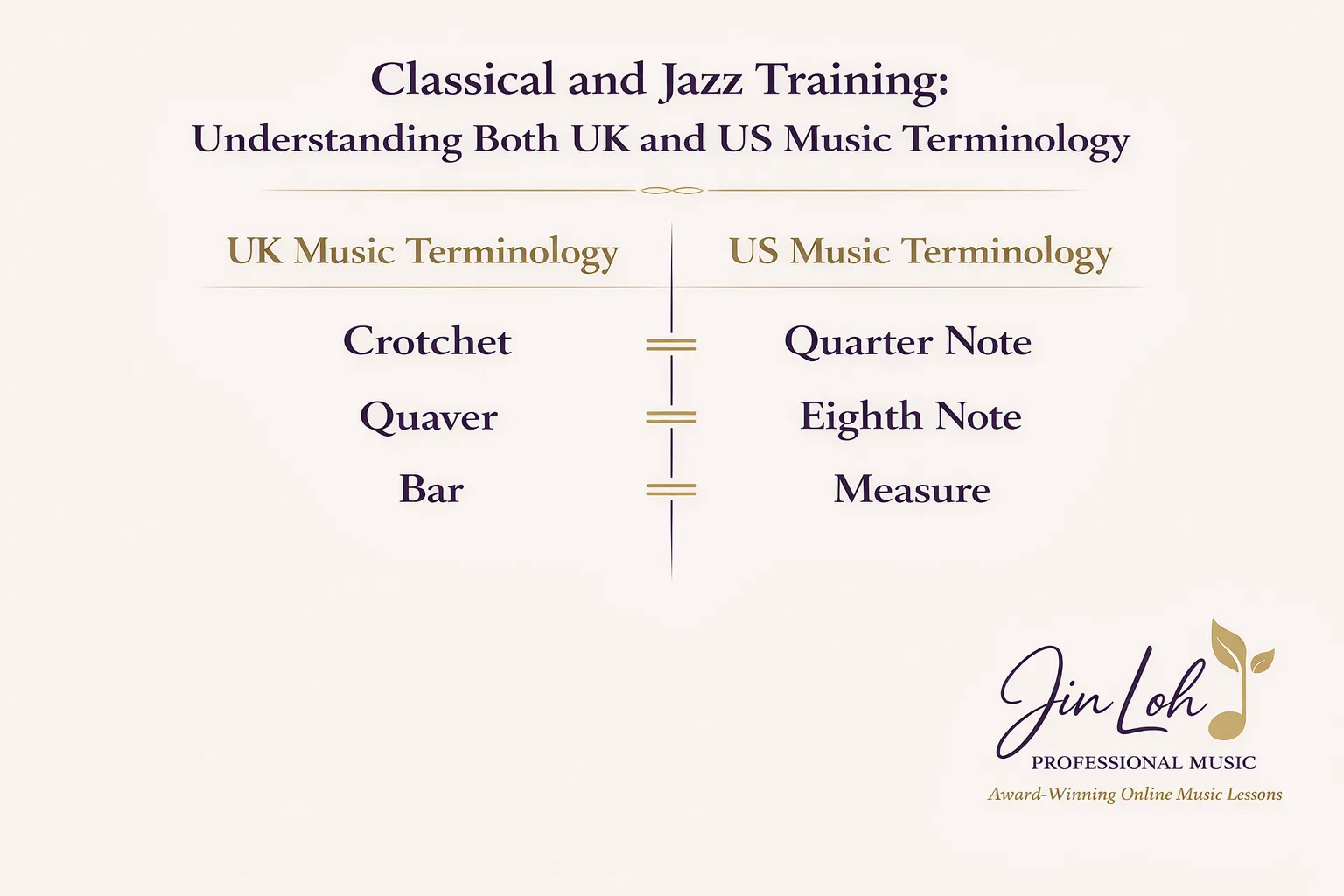
ABRSM Music Theory is based on the British system of music terminology, reflecting the traditions of Western classical music education in the United Kingdom. As a result, students preparing for ABRSM examinations learn terminology such as crotchet, quaver and bar, which are commonly used within the UK musical system.
However, musicians working within other musical traditions—particularly in jazz and contemporary music education in the United States—often use a different set of terms. For example, what is known as a "crotchet" in the UK system is commonly referred to as a "quarter note" in the American system, and the term "bar" is often described as a "measure".
As a professional musician formally trained in both Western classical music and Contemporary Jazz Harmony Studies, international award-winning music educator Ms Jin Loh is familiar with both terminology systems. While students preparing for ABRSM Music Theory examinations learn the official UK terminology required for the exam, Ms Jin Loh also explains the equivalent American terminology used in jazz and contemporary music education.
This broader perspective helps students understand that these terms describe the same musical concepts, allowing them to communicate comfortably with musicians and teachers from different musical backgrounds.

Why Music Theory is Important for Musicians
Music theory provides musicians with the foundation to understand rhythm, harmony, musical structure and notation. It enables students to read music more fluently, analyse musical patterns, and develop stronger musicianship across all instruments and vocal studies.
For students preparing for ABRSM examinations, music theory also plays an important role in supporting practical performance studies. A strong foundation in music theory is essential for students preparing for ABRSM examinations, as theoretical knowledge supports musical understanding across all instruments and voice.
ABRSM Music Theory Grade 5 Requirement
for Higher ABRSM Practical Exams (Grades 6 & Above)
ABRSM Music Theory Grade 5 represents an important academic milestone within the ABRSM examination system. In order to proceed to ABRSM Grade 6, Grade 7 and Grade 8 practical examinations, candidates must have passed ABRSM Music Theory at Grade 5 or above. In other words, students must achieve at least a pass in Grade 5 Music Theory before they are eligible to enter the higher practical grades (grades 6-8).
This requirement applies to all musicians, regardless of their instrument or area of study, including pianists, violinists, cellists, guitarists, singers, flautists and other instrumentalists preparing for ABRSM practical examinations. The requirement also applies to both in-person practical examinations at ABRSM examination centres and the ABRSM online performance exam format.
The ABRSM examination system normally verifies that candidates have met this theory requirement through records held in the ABRSM database. In some cases, particularly if a candidate completed their theory examination many years ago, the record may not appear in the online system. In such situations, ABRSM may request that the candidate provide proof of their Music Theory Grade 5 and above's qualification, such as an ABRSM certificate or marksheet, before the practical examination result is formally confirmed.
If the required theory qualification cannot be verified, the candidate's Grades 6-8 practical examination result will not be validated according to ABRSM examination regulations.
International Recognition of ABRSM Online Music Theory Examinations
ABRSM Music Theory Grade 5 is an important milestone, as a pass in Grade 5 theory and above, is required before students mto Grade 6 and above ABRSM practical examinations.
ABRSM Music Theory Grades 1-5 examinations are now conducted through an official online digital examination format, allowing students worldwide to take their theory examinations from their own country. These online theory examinations are part of the official ABRSM examination system and are internationally recognised.
Students who complete ABRSM Music Theory Grades 5 online remain fully eligible to proceed to Grade 6, Grade 7 and Grade 8 practical examinations. These Grades 6-8 practical examinations may be taken either at an ABRSM examination centre in person (physical face to face) or through the ABRSM online performance exam format, depending on the student’s preference.
For example, a student studying ABRSM Music Theory online may prepare for the examination with Ms Jin Loh and then sit for the official ABRSM online theory exam from their home country, such as Singapore, Malaysia, Thailand, Hong Kong, the United Kingdom, the United States or other international locations.
When students are ready for the examination, Ms Jin Loh assists with registration for the ABRSM Online Music Theory Examination. Students then sit for the exam using their own computer in their home environment. Once the examination has been completed, results are released by ABRSM, and successful candidates receive an official ABRSM certificate.
An electronic certificate is issued as standard upon successful completion of the examination. Students who prefer a printed certificate may request one from ABRSM (a separate printing and postage fee charged by ABRSM applies, depending on the country of delivery).
This system enables students from different parts of the world to study ABRSM Music Theory online and complete their examinations in a convenient and internationally recognised format.
Educational Psychology Approach to Music Theory Learning
Ms Jin Loh’s teaching approach to ABRSM Music Theory is informed by her studies in Educational Psychology.
Through her training in Educational Psychology, Ms Jin Loh developed a deeper understanding of how students process information, build conceptual understanding, and develop long-term learning retention.
Rather than relying only on memorisation, lessons are designed to help students understand the logic behind music theory concepts and to recognise patterns in rhythm, harmony, and musical structure.
This approach allows Ms Jin Loh to observe how different students learn most effectively and to adapt explanations accordingly — whether through visual examples, step-by-step analytical thinking, or musical pattern recognition.
As a result, students often find complex theory concepts clearer and more intuitive, enabling them to build a strong and lasting theoretical foundation for their musical development.
This learning approach contributes to the consistently strong examination results achieved by Ms Jin Loh’s music theory students over the years.
International Recognition as
an Award-Winning Music Educator
ABRSM Music Theory Online Lessons at Jin Loh Professional Music are taught by internationally recognised music educator Ms Jin Loh.
Ms Jin Loh has received over 40 international Outstanding Music Educator and Teacher Awards from various international music competitions. These recognitions honour her long-standing contributions to music education and her dedication to nurturing students’ musical potential.
With more than 26 years of teaching experience, Ms Jin Loh brings both deep musical knowledge and refined teaching insight to her music theory lessons. Her students benefit not only from structured preparation for ABRSM Music Theory examinations, but also from a clear and comprehensive understanding of how music works.
Learning under an internationally recognised and award-winning educator offers students a rare opportunity to study within a high-level musical environment that values artistic excellence, thoughtful guidance, and long-term musical development.
Study ABRSM Music Theory with
an International Award-Winning Music Educator
Students who wish to prepare for ABRSM Music Theory examinations, or who would like to deepen their understanding of music through music theory, music appreciation, or music history, are welcome to study under the guidance of internationally recognised music educator Ms Jin Loh.
With more than 26 years of teaching experience and international recognition for her contribution to music education, Ms Jin Loh provides carefully structured online lessons that help students develop a clear and lasting understanding of music.
Lessons are suitable for students preparing for ABRSM Music Theory Grades 1–8, as well as for musicians who wish to strengthen their musical knowledge and theoretical foundation.
For lesson enquiries, please contact Jin Loh Professional Music.
 Music Education is not about training musicians, but about cultivating human beings - Sukhomlinsky


Home About Ms Jin Loh Contact Us Privacy Policy
By Jin Loh Professional Music (since 1999).
Copyright © 2013-2026 JinLoh-Professional-Music.Com.
All Rights Reserved