日本語プロフィール:ジン先生は約6年間日本語を学び、いくつかの国際日本語試験に合格しました。
International Music Competition Judge
50+ Gold Prizes Won by Students
40+ International Teacher Awards
International Interviews (UK)
2025: Global Influential Times &
World Org. for Art & Design
2024: Beeffie Artist Award Org.
Discover what international winners say about learning under Ms. Jin Loh (watch video 2.5 mins)

How Singing Improves Your Health:
Evidence-Based Benefits for Body and Mind
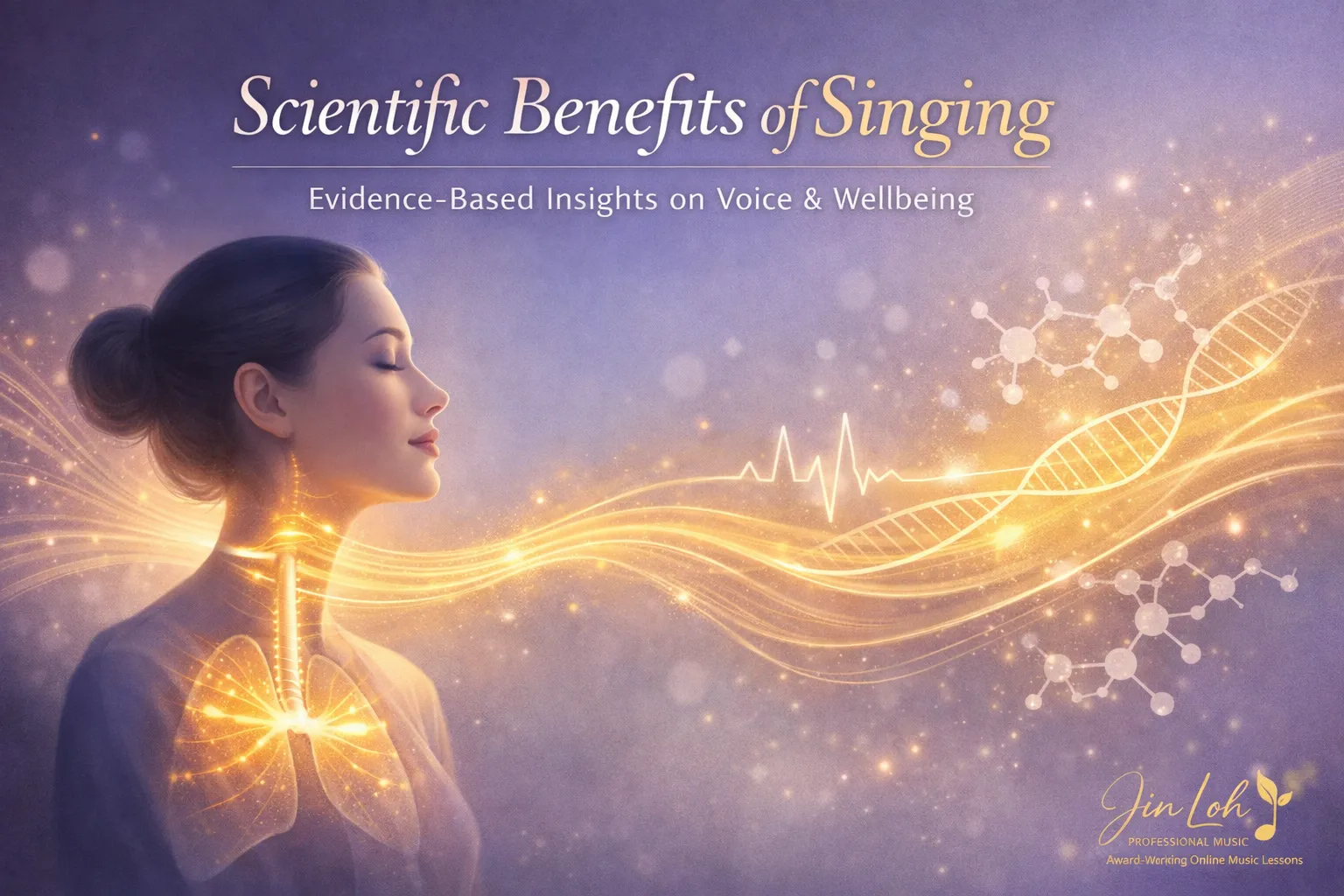 Evidence-based insights into the health benefits of singing.
Many people search online for benefits of singing, scientific benefits of singing, or how singing improves health. While singing has long been valued culturally and artistically, modern research in psychology, physiology, and medicine has also begun to examine its measurable effects.
According to Harvard Health Publishing, active engagement with music—including singing—is associated with improvements in emotional wellbeing and quality of life. Rather than relying on anecdotal claims, a growing body of peer-reviewed research now explores how singing may influence stress hormones, breathing patterns, immune markers, and social connection.
Below is a research-based overview of what studies have actually observed—and what those findings mean in practical terms.
Singing and Stress Reduction
(Cortisol, Mood and Emotional Regulation)
A study published in Frontiers in Psychology (Kreutz et al., 2004) examined the effects of singing compared to passive listening in healthy adults. Researchers observed that participants who engaged in active singing showed significant increases in positive mood and measurable reductions in stress-related markers, compared to listening conditions.
In another controlled study published in Psychology of Music (Valentine & Evans), singing was associated with reduced tension and increased feelings of relaxation among participants following structured vocal sessions.
Harvard Health Publishing has also reported that active musical engagement—including singing—can lower stress responses and promote emotional regulation through breath control and focused attention.
Together, these findings suggest that singing may support stress physiology by combining rhythmic breathing, vocal vibration, and emotional expression.
Immune-Related Biomarkers
(Immunoglobulin A and Biological Changes)
A study published in the journal Psychology of Health (Beck et al., 2000) found that participants showed increased levels of secretory immunoglobulin A (S-IgA) after singing compared to baseline measurements. S-IgA is an antibody involved in immune defense.
In the 2016 Fancourt study mentioned earlier, researchers also observed changes in cytokine activity—proteins involved in immune signaling—following singing sessions.
It is important to clarify that these findings do not mean singing “prevents illness.” Rather, they demonstrate measurable short-term changes in biological markers related to immune function.
Breathing and Cardiovascular Regulation
(Heart Rate Variability)
A study published in Frontiers in Psychology (Vickhoff et al., 2013) investigated heart rate variability (HRV) during singing. Researchers found that structured singing patterns were associated with increased heart rate variability and synchronized breathing patterns among participants.
Higher HRV is generally associated with better autonomic nervous system balance and stress resilience.
Harvard Medical School has discussed HRV as an indicator of cardiovascular adaptability, and emerging research suggests that controlled vocal breathing—such as that used in singing—may positively influence this regulation.
In practical terms, singing involves prolonged exhalation and diaphragmatic engagement, similar to certain breath-regulation techniques used in stress management.
Social Bonding and Endorphins
A study published in Royal Society Open Science (Pearce et al., 2015) found that group singing accelerated social bonding compared to other group activities.
Another study in Evolution and Human Behavior (Dunbar et al., 2012) reported increases in pain thresholds after singing rehearsals—a proxy indicator linked to endorphin release.
These findings suggest that singing may stimulate neurochemical processes involved in social connection and reward pathways.
Brain Activation and Cognitive Engagement
According to Harvard Health Publishing, music engagement activates widespread neural networks related to memory, emotion, and executive function.
Neuroimaging research shows that singing engages multiple brain regions simultaneously, including those responsible for language, motor coordination, and emotional processing. This whole-brain activation may explain why musical activity is often linked with cognitive stimulation across age groups.
While research continues to evolve, music participation—including singing—is increasingly studied for its potential contribution to cognitive health.
Traditional Perspectives on Vocalization and Well-Being
Long before modern laboratory studies, many traditional systems of health viewed vocal sound and breath as regulating internal balance.
From a physiological perspective, singing combines breath control, resonance, posture, and emotional expression—making it a whole-body activity rather than purely artistic expression.
Modern scientific observations about breathing regulation, stress hormone modulation, and autonomic balance offer measurable parallels to these long-standing perspectives.
Conclusion
Across clinical studies, systematic reviews, and physiological research, singing has been associated with:
- Reduced stress hormone levels
- Improved mood and emotional regulation
- Measurable immune-related biomarker changes
- Increased heart rate variability
- Enhanced social bonding
- Whole-brain activation
While singing is not a medical treatment, research suggests it is a biologically active and psychologically meaningful practice.
Ready to Experience the Benefits of Singing for Yourself?
Those interested in pursuing structured, award-winning singing lessons may learn more about private online singing lessons guided by international award-winning singing educator Ms Jin Loh.
→ Contact Jin Loh Professional Music
Professional Disclaimer
The information presented on this page is provided for educational and informational purposes only. While the research cited reflects findings from peer-reviewed studies and reputable academic sources, singing is not a medical treatment and is not intended to diagnose, treat, cure, or prevent any health condition.
Participation in singing activities or enrolment in Ms Jin Loh’s singing lessons should not be considered a substitute for professional medical, psychological, or therapeutic care. Individuals experiencing physical or mental health concerns are advised to seek guidance from a qualified healthcare professional.
Any potential wellbeing benefits associated with singing may vary between individuals and should not be interpreted as guaranteed health outcomes.

 Music Education is not about training musicians, but about cultivating human beings - Sukhomlinsky


Home About Ms Jin Loh Contact Us Privacy Policy
By Jin Loh Professional Music (since 1999).
Copyright © 2013-2026 JinLoh-Professional-Music.Com.
All Rights Reserved